

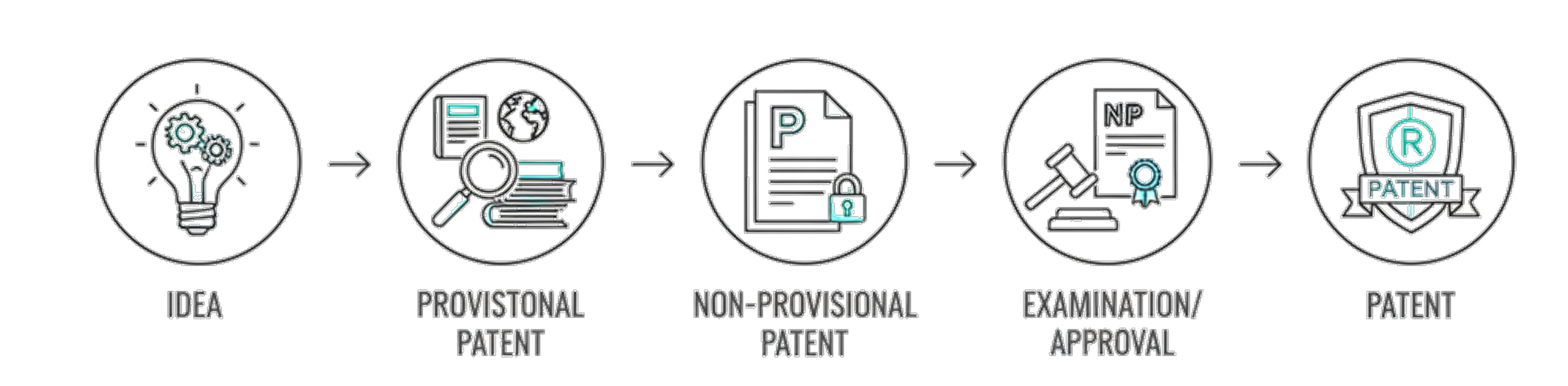
Preparation & Planning at Each IP Roadmap Stage
Your IP roadmap should follow your product roadmap, not outrun it. At each stage of development, there are a few simple preparation and planning steps that make the next IP move faster, clearer, and more cost-effective. Use the guide below to know what to get ready before you move forward.

- Plan before you spend – a little structure early reduces rework later.
- Align IP with product – don’t patent old versions you’ll never ship.
- Document everything – sketches, notes, variations all become useful drafting fuel.
- Stay flexible – searches and drafts may refine how you describe or scope the invention.
Goal
Get clear on what your invention actually is and what problem it solves.
Preparation & Planning
- Write a short narrative in plain language: what it does, who it helps, and why it’s better.
- Sketch simple diagrams or block diagrams (even rough hand drawings).
- List the major components, functions, and optional features or variations.
- Note any similar products or ideas you’ve already seen.
Why it matters: A crisp concept description makes every later step—search, drafting, and filing—faster and more accurate.
Goal
Understand what already exists so you can shape your innovation and filing strategy.
Preparation & Planning
- Highlight the core functions and keywords you’d use if you were searching for your own idea.
- Identify target users, use cases, and markets where your solution would live.
- Capture known competitors or products you suspect might be close.
- Write down specific questions you want answered, such as:
- “How crowded is this space?”
- “What seems truly different about my approach?”
- “Are there obvious claim directions to explore or avoid?”
Why it matters: A good landscape read helps you avoid blind spots, refine your concept, and budget realistically for IP—before spending heavily on drafting.
Goal
Secure an early USPTO filing date and patent-pending status with a solid, detailed description.
Preparation & Planning
- Expand your narrative into a more detailed story: how it works step-by-step.
- Describe multiple examples, variations, and alternative implementations.
- Gather sketches, screenshots, or diagrams that help explain structure and flow.
- List the features you consider “core” vs. “nice-to-have.”
Before you submit: Re-read your description for completeness. Ask, “If someone skilled in the field read this, could they rebuild it?”
Goal
Turn your detailed input into a structured provisional or full draft that’s ready to file or refine.
Preparation & Planning
- Set aside time to review the draft carefully for technical accuracy.
- Add or refine figures, callouts, and descriptions of different embodiments.
- Flag any areas that feel under-explained or ambiguous so they can be strengthened.
Practice: Keep track of versions and comments so you can see how your invention description evolves over time and reuse that work later (e.g., for non-provisional drafting).
Goal
File a full utility patent application that will be examined and can mature into an issued patent.
Preparation & Planning
- Use prior art and product learnings to refine claim scope (what you want to protect most).
- Decide which embodiments and variations should be claimed vs. only described.
- Prepare or finalize professional patent drawings (or 3D CAD files for drawing creation).
- Plan for budget: drafting, USPTO filing fees, and future prosecution (Office Actions).
Outcome: A formal, USPTO-ready application that reflects how your product actually works and where it sits relative to known art.
Goal
Protect the ornamental appearance of your product as a complement to functional coverage.
Preparation & Planning
- Identify which visual aspects (shape, contour, surface features) are most distinctive.
- Prepare clear multi-view drawings or 3D CAD models suitable for design figures.
- Decide whether design and utility filings should be coordinated around launch timing.
Why it matters: Design patents often provide fast, clean protection for the look of your product, which can be powerful in consumer-facing markets.
Goal
Work with the USPTO examiner through Office Actions and responses toward allowance.
Preparation & Planning
- Track all deadlines carefully; missing one can be expensive or fatal to a case.
- Review the cited prior art to understand why the examiner pushed back.
- Decide where you’re willing to narrow claims and where you want to hold your ground.
- Plan budget for response drafting and, if needed, follow-up rounds.
Mindset: Prosecution is a conversation. The goal is not just to “argue back” but to land on claim language that is both allowable and meaningful for your business.